


 24 / 72

Operating Budget Submission
e primary budgeting objective of the College is to allocate resources in an efficient
and effective manner consistent with its strategic priorities. our operating budget
continues to be under considerable pressure due to projected cost increases
related to employee healthcare, contractual salary agreements and the operation of new
buildings. As we began developing the 2016-2017 operating budget, i directed all
College departments to submit “no growth” budgets for non-personnel expenditures,
with an exception for costs associated with operating our new buildings.
Departmental budget requests, when combined with anticipated expenses, resulted in
an initial projected budget gap of $13.9 million. working closely with our office of
Business and financial Affairs and with direction from the members of the Board’s
Budget and finance subcommittee, we were able to identify $1.1 million in cuts that
could be made without impacting upon our core operations. is brought the budget
gap down to $12.8 million. A major factor behind the budget gap is a revenue
shortfall of $8.3 million that is primarily due to a 3% decline in enrollment for 2015-
2016 and our budget assumption for another 1% decrease in 2016-2017. in addition,
for the fourth year in a row, the operating budget will only be balanced through the
use of reserve funds.
e College’s 2016-2017 operating budget is $216 million, an increase of $4.4 million
or a nominal 2.1% over the prior year’s budget. it is one of the smallest percentage
increases to be requested over the last five years. To support this request, the adopted
New York State 2016-2017 budget provides an increase in State Base Aid per full
Time equivalent (fTe) student of $100 per fTe, which translates to $1.9 million in
additional revenue for the College and changes the base aid rate from $2,597 to
$2,697 per fTe. e College asked for and received a 2.5% increase in the County
contribution, which provides the institution with $1 million in additional revenue.
for the fourth year in a row, the County has increased its funding of the College over
the funding received in the previous fiscal year. we are grateful for the support from
all of our elected officials that understand the importance of investing in education.
in order to address the remaining gap, the Board of Trustees engaged in considerable
discussion and examination of several budget scenarios. e expectation for enhanced
services through technology has placed increased demands on our budget for several
years. Advancing a positive student learning environment includes management of a
viable computer replacement program, access to smart
classrooms and student computer labs, as well as a digital
library, digital research, online learning and enhanced
communication through mobile apps, text messaging and a
robust website. in addition, concerns related to cyber-attacks
are ever present. e demand for technology – including
hardware, software, licensing and upgrades – has outpaced
the ability of the current revenue stream to support our
operational needs. As a result, the Trustees authorized an
increase in the Technology fee from $80 a semester to $125
per semester. is is the first increase to this fee in five years.
A determination was also made to implement a $4 increase
to the student activity fee, bringing it from $96 to $100
per semester.
in addition, a recommendation was approved by the Board
of Trustees to increase tuition by an annual amount of $200.
23
❘
2015-2016 Review of Accomplishments
20
30
40
50
60
Student Share
State Share
County Share
2015-
2016
(requested)
2015-
2016
(adopted)
2014-
2015
2013-
2014
2012-
2013
2011-
2012
2010-
2011
2009-
2010
2008-
2009
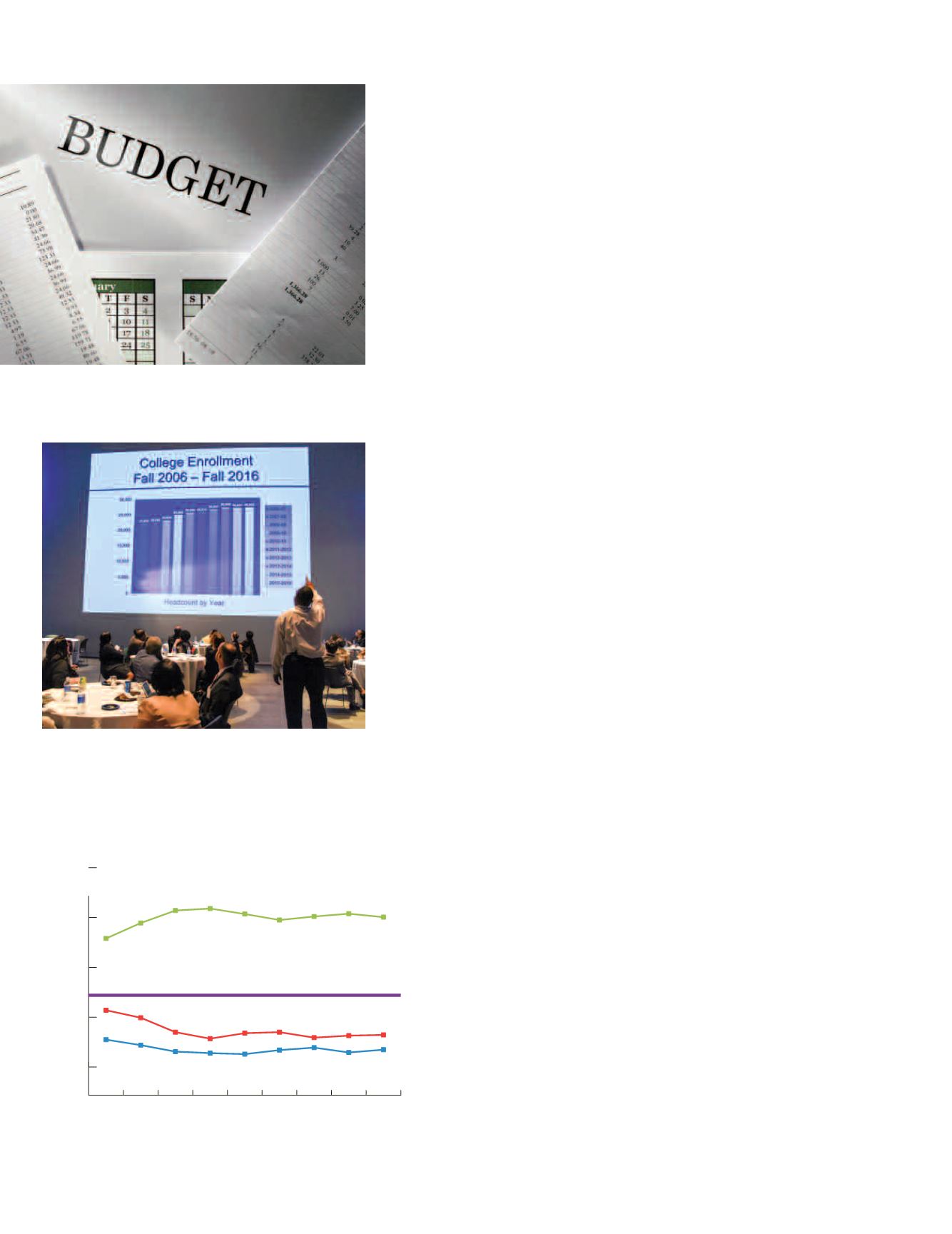
Net Operating Revenue
Academic Year
Percentage of Revenue
⅓ Revenue Support
(equal shares)
Community leaders are updated about the College’s budget highlights.