


 19 / 72

of over 100 applied learning experiences (e.g., internships, co-ops, service learning)
currently available to Suffolk students. e ultimate goal is to increase applied-
learning opportunities for all students enrolled across the SUNY system.
Enrollment
our total full Time equivalent (fTe) enrollment saw healthy new student
enrollment, but erosion in our continuing student numbers. in addition, we saw an
uptick in part-time students and a decrease in full-timers. e model maintained by
the College’s office of Planning and institutional effectiveness (oPie) projects a
modest leveling off in fTe’s for 2016-2017, and this year’s budget was prepared based
upon enrollment trending 1% less as compared to 2015-2016 actual enrollment.
rough our marketing and enrollment management efforts, we have successfully
mitigated dramatic changes in our enrollment levels. is is a distinctly different
outcome compared to other community colleges in the state that have experienced
enrollment declines, some in the double digits. other colleges also made decisions
to close certain programs in response to financial challenges in the marketplace. is
did not occur at Suffolk.
e initial draft of the 2016-2021 Strategic enrollment plan is being prepared for
internal review and further refinement. e plan has identified targeted cohorts that
will advance our recruitment efforts through the development of action plans. Lead
responsibility for the various targeted cohorts within the plan is being identified.
we are maintaining our focus on enhanced retention and student persistence to
completion, especially as we continue to see large graduating classes each spring.
extensive marketing activities have been implemented to support the College’s
enrollment management efforts.
is year, the College’s Student engagement Committee worked to develop the first
draft of a comprehensive Student engagement plan to support student persistence
through meaningful faculty and administrative-driven initiatives that engage our
at-risk populations in order to increase student success.
ere is a high level of synergy between the College’s offices of institutional
Advancement and Student Affairs. Since March, through a variety of platforms, staff
from these areas have been developing creative ways of communicating with students
from Suffolk County who are attending institutions other than our own. Media,
direct mail, geo-fencing with mobile ads, e-blasts, and outreach to the guidance
community are just a few of the approaches that have enabled the College to connect
with prospects seeking to learn more about the College’s programs and opportunities.
As part of the office of institutional Advancement’s outreach plans, we have been
working with an integrated broadcasting, publishing and digital media company that
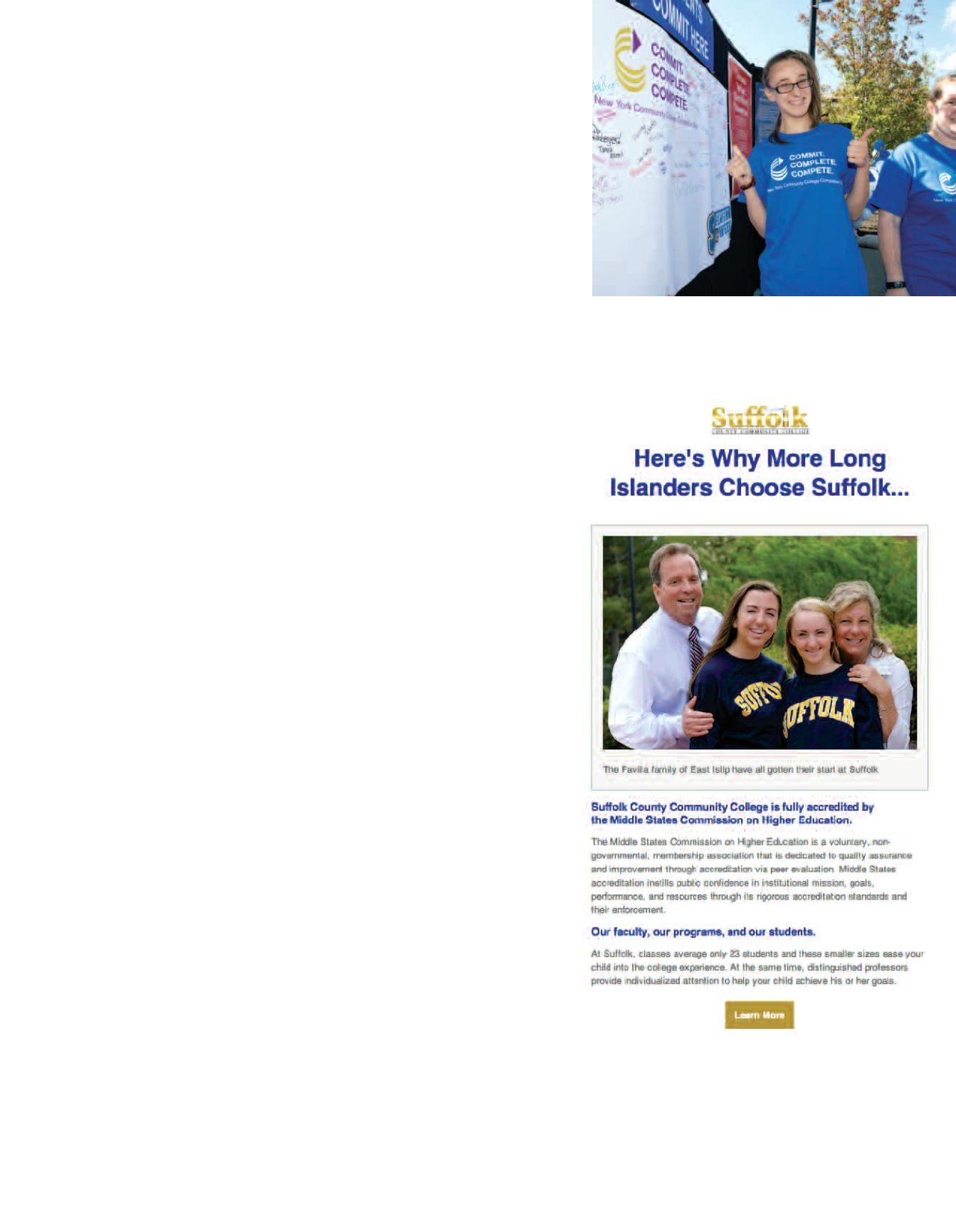
partners with us in selected digital-marketing efforts. As an example, a recent e-blast
was sent to nearly 90,000 email addresses. e e-blast had an open rate of 10.02%
(the average is 5-7%) and the click-through rate was .99% (the average is .5-1.0%). As
a result, the College now has contact information for this group of prospects that the
office of enrollment Management can use to initiate follow-up communications.
is year saw numerous changes to the landscape of higher education on Long island.
Briarcliffe College announced its plans to close two Long island campuses in
Patchogue and Bethpage by the end of 2018. As a result, the offices of institutional
Advancement and enrollment Management worked together to launch an innovative
"geo-precise" mobile-based campaign that sent advertising messages specifically to the
cellphones of people within the physical limits of the two Briarcliffe campuses.
2015-2016 Review of Accomplishments
❘
18
e College continues to create and support initiatives that
enhance retention and lead to student completion.
Online communication efforts, like targeted e-blasts,
have helped to identify potential students by reinforcing the
College’s key advantages.